.png)
Published September 25, 2026
Thinking About Retiring in Northern Michigan? Make Sure You Can Handle These 6 Things

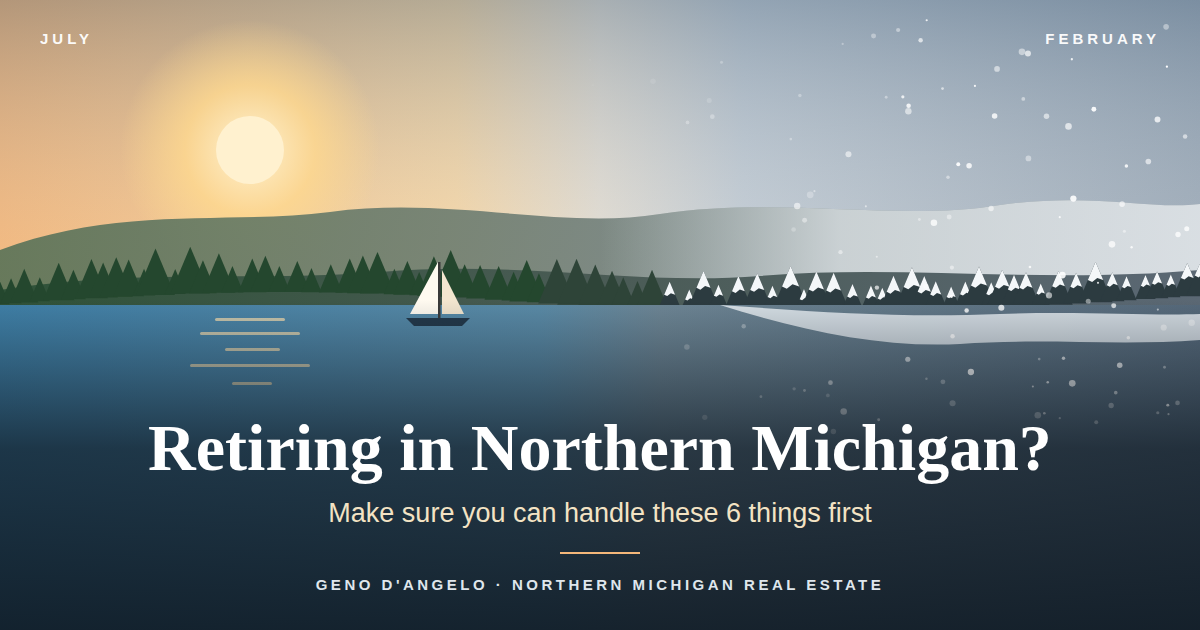
I've talked retirees out of moving to Northern Michigan. On purpose, even though it cost me the sale.
That's not because this is a bad place to retire. It's one of the best. But it's the best for a specific kind of person, and the only way to know if that's you is to look honestly at the parts a summer vacation never shows you.
I'm Geno D'Angelo. I've spent more than 20 years helping over 700 families retire, relocate, or find a second home here in Northern Michigan. Below are the six tests I walk every retiree through. If you can handle all six, this may be the best decision you ever make. If you can't, you'll want to know before you sell the house downstate.
At the end, I'll share the one step I recommend to every retiree before they buy. It costs a few hundred dollars and could save you from a six-figure mistake.
1. Can you handle February?
Not December. December is easy to love, with Christmas lights in downtown Petoskey, fresh snow on the bay, and dinner at Chandler's with the fireplace going.
February is the real test. By then:
- The holidays are over.
- The gray has settled in for weeks at a time.
- The days are short.
- A lot of your neighbors are gone.
That last point surprises people. Plenty of retirees here are snowbirds who leave after the holidays and return in April. The street that felt so friendly in July can feel very quiet in February.
The honest other side is that winter here isn't just something to survive. You can ski Nub's Nob or Boyne Mountain, snowshoe, catch the winter festivals, and play indoor pickleball. The people who love it here year-round have a winter routine.
The test: Do you have a plan for February, or just a plan for August? If you don't have one yet, that's fine. Build it before you buy.
2. Can you handle the drive to a specialist?
At this stage of life, healthcare isn't a side issue. It's the issue.
The good news is real. McLaren Northern Michigan in Petoskey and Munson Medical Center in Traverse City are serious regional hospitals. Everyday care, emergencies, and a lot of specialty care are handled right here.
The catch:
- For some specialists and advanced treatments, you may be driving to Grand Rapids, Ann Arbor, or Detroit.
- That can mean three to four hours each way.
- In winter, that drive isn't always a sure thing.
- A series of appointments means many trips, not one.
The test: Look honestly at your health and your spouse's. If you depend on a specific specialist today, find out where the nearest one practices before you fall in love with a lake house. One phone call is the difference between an informed decision and a painful surprise in year two.
Weighing a specific town? Message me and I'll tell you straight how far it really is from the care you need.
3. Can you handle the property tax reset?
This catches more retirees off guard than almost anything else, and almost nobody explains it.
In Michigan, a home's taxable value is capped for as long as the owner keeps it, so it can only rise a little each year. If the sellers have owned that cottage for twenty years, their tax bill may be well below what the house is worth today.
When you buy it, that cap comes off. The following year, the taxable value resets closer to today's market value. That means:
- The seller's tax bill is not your tax bill.
- Budgeting off the number in the listing can leave you off by thousands a year.
- On a fixed income, that's a real line item every year, not a rounding error.
There's a second piece. If the home becomes your primary residence, you can file for Michigan's principal residence exemption, often called the homestead exemption, which can lower your bill meaningfully. But you can only claim it on one home. If you keep the downstate house as your primary for a while, the northern home is taxed at the higher rate in the meantime.
The test: Can you handle the real tax number, not the seller's? Before you make an offer, ask your agent to estimate the uncapped taxes, then confirm it with the local assessor. It's simple, and it's the step people skip most.
4. Can you handle starting over socially?
This is the one nobody says out loud, so I will.
Downstate, you have decades of relationships: neighbors who've known your kids since they were in diapers, and friends you never have to explain yourself to. Up here, you start from zero.
- Friendships at this stage don't happen by accident.
- Summer makes it feel easy, because everyone is out and friendly.
- But summer friends and year-round friends aren't always the same people.
The good news is genuinely good. The year-round community here is warm, active, and full of people who made this exact move. There are golf leagues at Crooked Tree and Boyne Highlands, pickleball groups that play all year, and volunteer boards, sailing clubs, and walking groups that meet even in the snow.
The people who thrive here join something in their first ninety days. The people who struggle wait for it to come to them.
The test: Are you willing to be the one who shows up first? If you are, you'll build a real circle faster than you'd think.
My free local relocation guide lists the clubs, leagues, and groups where newcomers actually connect, so you're not starting from a blank page.
5. Can you handle being the destination?
When you lived twenty minutes from the kids, you went to them for Sunday dinners, soccer games, and birthday parties. Move up here, and you become the destination.
- Your kids have jobs, school calendars, and busy lives of their own.
- A visit now means a four- or five-hour drive, or a flight.
- Flights are limited. Pellston is close to Petoskey but has only a few daily options, mostly connecting through Detroit. Traverse City offers more routes but is a longer drive.
- The easy drop-in weekend visit gets harder.
Be honest about timing, too. The grandkids will want to come in July. February, maybe not so much.
The flip side is a big one. When they do come, you're giving them something special: summers on the lake, learning to fish off the dock, ice cream downtown after a day on the water. You're building the place they'll talk about for the rest of their lives.
The test: Are you okay trading frequent visits for fewer, bigger ones? Some families love that trade, and others learn the hard way that they miss the little things. Have that conversation with your kids before you move, not after.
6. Can you handle this house at 80?
When you tour homes at 64, you picture yourself today: active, healthy, and ready for the lake. The smartest retirees I work with picture themselves at 80.
Many homes that look perfect on a summer visit come with features that get harder every year:
- Sixty steps down a bluff to the waterfront.
- A long private driveway that needs plowing after every snowfall.
- A main bedroom on the second floor.
- A location twenty-five minutes from town, groceries, and the hospital.
None of that is a dealbreaker at 64. Some of it could be at 80. And good contractors, plow services, and caretakers book up fast here, so line those relationships up before your first winter, not during it.
This doesn't mean skip the lake. It means buy the right lake house. Look for main-floor living, an easier grade down to the water, and a location that keeps you close to town and to care. There are beautiful homes here that check every box. You just have to know to look for them.
The test: Is this the house for the next five years, or the next twenty?
If you want help finding homes that fit both versions of you, the one today and the one at 80, book a quick call with me.
Why people still move here and never look back
If a few of those tests made you uneasy, good. It means you're taking this seriously.
Knowing all of it, people still retire here and never look back. It's a slow morning with coffee on the porch and the bay flat as glass. It's a round at Boyne Highlands in the afternoon and dinner at Walloon Lake Inn at sunset. It's knowing the people at the hardware store by name, and a pace of life that's hard to find anywhere else.
For the right person, that isn't a trade-off. It's the whole point.
The one thing to do before you buy
Rent a place for a few nights in late February, or in April during mud season. Not August, and not the Fourth of July.
Go to the grocery store. Drive the roads. Sit in the house on a gray afternoon and ask yourself honestly how it feels. Off-season, that can cost a few hundred dollars, and it could save you from a six-figure mistake.
If you still love it in February, you're ready, and you'll buy with confidence instead of hope.
Ready to talk it through?
If you're thinking about retiring in Northern Michigan, I'd love to help you do it the right way, with honest numbers, the right house, and no pressure.
- Book a call: 231-487-6141
- Follow me on Instagram @GenoDAngeloRealtor
- Watch the video version on my YouTube channel, @genodangelorealtor
Geno D'Angelo is a Northern Michigan real estate broker with Real Broker, serving Petoskey, Bay Harbor, Harbor Springs, Burt Lake, Mullett Lake, and the surrounding lakes.